Cutting calories is the oldest weight loss advice in the book. Under chronic stress, it can make your body push back harder.
That sounds unfair because it is. Your body does not read a calorie deficit as a spreadsheet entry. It reads low fuel, poor sleep, high pressure, and constant vigilance as one message: conserve energy.
This is where cortisol matters. Cortisol helps you mobilize fuel during stress, but when the stress never really resolves, the same system can drive hunger, cravings, abdominal fat storage, and a slower metabolic rate.
So when you search why can't I lose weight stress, the answer is rarely one thing. It is usually a loop.
Quick answer
Stress can make weight loss harder because cortisol helps regulate fuel, appetite, blood sugar, sleep, and fat storage. A calorie deficit still matters, but chronic stress can make that deficit feel harder to sustain by increasing hunger, cravings, fatigue, and metabolic adaptation.
The better first step is often stress-load reduction, protein, steady blood sugar, sleep consistency, and targeted support for the cortisol loop before cutting harder.
The model that does not account for stress
Calories still matter. A calorie deficit still creates the basic condition for weight loss.
The problem is that the usual “eat less, move more” advice assumes a hormonally neutral body. Chronic stress changes that environment before the diet even starts.
One well-cited 2010 randomized controlled trial published in Psychosomatic Medicine followed 121 women assigned to calorie restriction and calorie monitoring. Restricting calories increased total cortisol output, while tracking calories increased perceived stress.
Cortisol helps your body manage energy when life feels demanding. So when stress is already high, a stricter diet can feel less like a simple calorie change and more like another pressure signal your body has to handle.
You can be doing the plan correctly and still be working against your own physiology.
This is why dieting does not work the same way during a calm season and a stretched-thin season. The math may look the same on paper, but your hormones are reading the situation differently.
The cortisol-appetite loop
Cortisol affects appetite because survival requires fuel. During short-term stress, that can be useful. During chronic stress, it gets messy.
A review on stress and appetite explains that cortisol, insulin, and appetite-related hormones all interact with future weight gain risk. That means stress and weight gain in women cannot be reduced to discipline or food choices alone.
Ghrelin is the hormone that tells your brain you are hungry. Leptin is the signal that tells your brain you have enough stored energy and can stop seeking food.
When cortisol stays high, hunger can feel louder and fullness can arrive late. That is the part many diet plans ignore.
This is also where cortisol and blood sugar matters. If blood sugar drops between meals, cortisol rises to help bring glucose back up. That can feel like shaky hunger, a sudden need for something sweet, or the kind of “I need food now” feeling that does not respond well to willpower.
Why stressed brains want comfort food
Stress eating hormones are not imaginary. Your brain learns quickly that calorie-dense food can buffer discomfort for a little while.
A major review on stress eating behavior found that negative emotional states often shift people toward foods high in sugar or fat. Another paper found that comfort food is especially reinforcing in people reporting higher stress.
Here is what that means in real life: the brownie at 9 p.m. is not just “lack of control.” High-sugar, high-fat food activates reward pathways in the brain and can briefly soften the stress response.
Your brain remembers that. Then it asks for the same thing again the next time the day feels too heavy.
A separate review on eating and stress describes the same pattern: acute stress may reduce appetite for some people, while chronic stress tends to push intake toward highly palatable foods.
That is why a stricter diet can backfire. You are adding restrictions to a nervous system already looking for relief.
Why cortisol belly fat is different
Cortisol also affects where fat is stored. This is where the phrase “cortisol belly fat” comes from, though it is not a diagnosis.
Research on stress and abdominal fat links the cortisol awakening response with abdominal fat depots, and a larger review reports that long-term cortisol levels are especially related to abdominal fat mass.
Visceral fat sits deeper in the abdomen, around internal organs. It is metabolically active, which means it can send inflammatory signals that make the stress-metabolism loop harder to quiet.
This helps explain why some women notice weight settling around the midsection during high-pressure seasons, even when their food has not changed dramatically.
_11zon.png)
The caloric restriction paradox
Calorie restriction is a stressor. That sentence sounds strange only because diet culture has trained us to treat restriction as neutral.
Your body does not know the difference between “I am cutting for summer” and “food is less available than usual.” It sees lower energy intake and starts adjusting.
This adjustment is called adaptive thermogenesis. During sustained restriction, your body may lower resting metabolic rate, reduce non-exercise movement, and spend less energy processing food.
In plain terms, you unconsciously move less, burn fewer calories at rest, and need less food to maintain the same weight. The original deficit gets smaller.
That is one reason a plan can work for 4 weeks and then stall. The body adapted to the plan.
Caloric restriction can also make muscle maintenance harder. A study on anabolic resistance found that energy restriction impaired muscle-building response to resistance exercise, which matters because lean mass is one of the tissues that helps keep resting metabolic rate higher.
This is the part of “why dieting does not work” that gets oversimplified. Dieting can work in the right context, but prolonged under-eating during chronic stress can raise cortisol, increase hunger, reduce movement, and make muscle preservation harder.
That is a tough setup.
This is the part worth seeing visually: in the Tomiyama trial, calorie restriction did not just change food intake. It changed cortisol output too.
Why this hits women harder
Women are more likely to notice this loop when estrogen begins shifting. Perimenopause is often where the old advice starts to feel broken.
Estrogen helps shape how the HPA axis responds to stress. The HPA axis is the signaling loop between your brain and adrenal glands, and it helps decide how large and how long your cortisol response runs.
As estrogen becomes less predictable in perimenopause, stress responses can feel bigger and recovery can take longer. At the same time, declining estrogen makes it easier to lose lean mass and store more fat centrally.
That is why weight gain during perimenopause can feel sudden, even when your habits look similar. The hormonal setting changed around the same habits.
A recent review on women with obesity describes the interconnection between stress, eating behavior, and body adiposity. The useful part is the pattern, stress changes eating behavior, eating behavior changes metabolic risk, and adiposity can feed stress physiology back into the loop.
This also explains why generic advice lands badly for women in their late 30s, 40s, and 50s. The standard advice was often built around a younger hormonal environment.
If this sounds familiar, menopause belly fat gives a useful related lens on why midsection changes often show up when stress, sleep, estrogen, and cravings start moving together.
The HPA axis is the system that regulates the size and duration of your cortisol response. One 2025 double-blind trial of ashwagandha root extract in adults with chronic stress reported improvements in stress, eating behavior, and weight-management markers, while an earlier 60-day randomized controlled trial found that high-concentration ashwagandha root extract reduced serum cortisol in adults with stress.
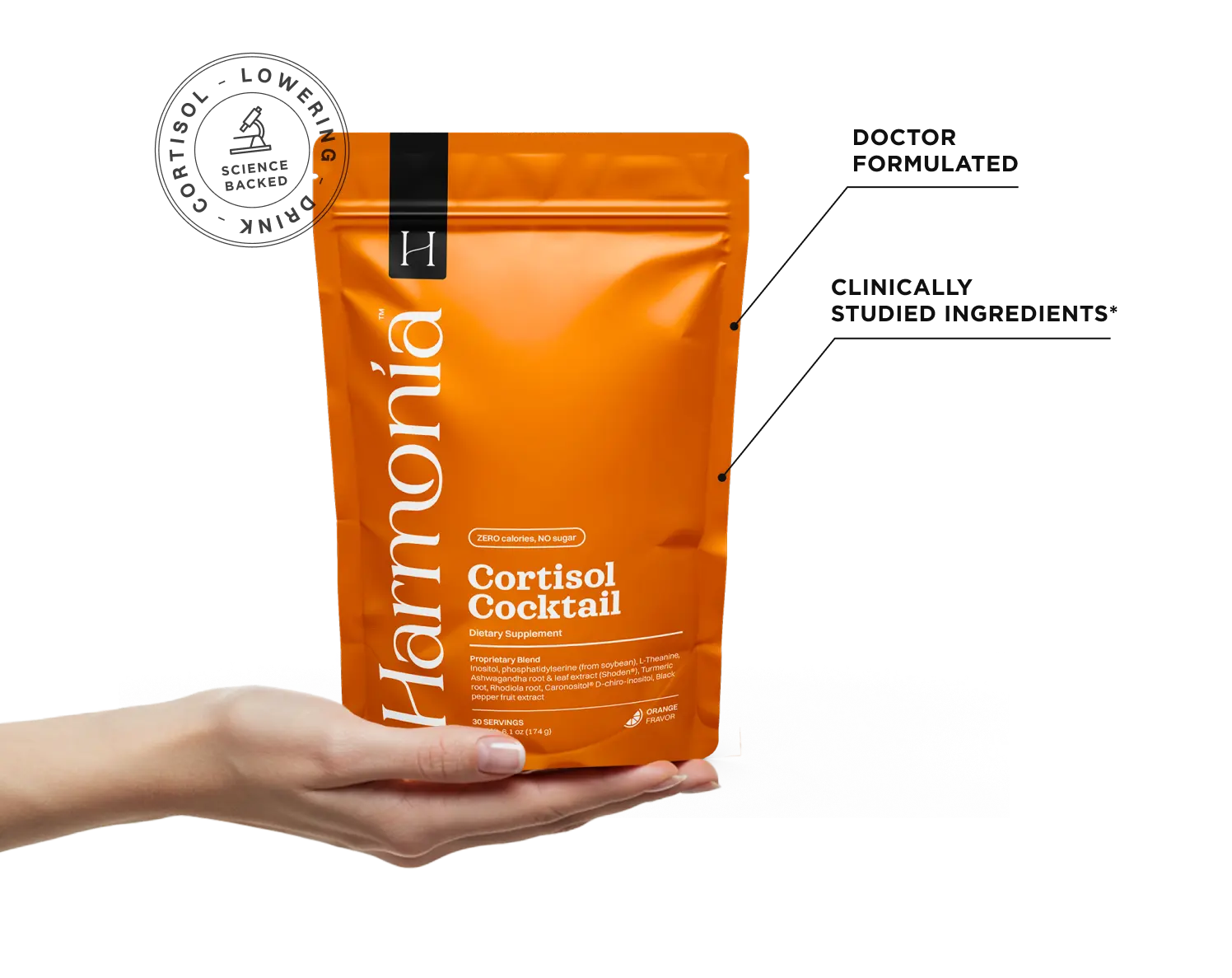
This is where ingredient choice matters. Harmonia’s Cortisol Cocktail includes KSM-66 Ashwagandha as part of a formula built around HPA axis support, alongside nutrients and adaptogens chosen for stress resilience rather than appetite suppression.
What helps before you cut harder
The first move is usually not a smaller meal. It is making your body feel safer metabolically.
That sounds soft until you look at the mechanisms. Stable fuel, consistent sleep, and lower stress load reduce the hormonal pressure that makes restriction feel unbearable.
If your current pattern feels like a mix of stress load, blood sugar swings, poor sleep, cravings, and stubborn midsection changes, start by looking for the pattern before choosing the next fix. The Harmonia quiz can help you sort where the stress-weight loop may be starting and whether stress-system support fits where you are right now.

Reduce stress load before tightening intake
If cortisol is already chronically high, aggressive restriction is fighting the current. The smarter sequence is to reduce the load first, then adjust intake from a steadier place.
A pilot trial of stress management added stress strategies to a behavioral weight program for women with moderate to high stress and found promising results. A randomized trial of stress management training in people with obesity also found greater improvements in BMI and eating behavior compared with diet alone.
This does not mean journaling replaces nutrition. It means stress physiology belongs in the plan.
For women after menopause, losing weight after menopause often needs this wider frame: muscle, sleep, stress, blood sugar, and food structure working together.
Prioritize protein at each meal
Protein is not magic. It is practical.
A meta-analysis found that acute protein intake suppresses appetite, decreases ghrelin, and increases satiety hormones such as GLP-1 and cholecystokinin. That gives your brain a clearer fullness signal when cortisol is trying to turn hunger up. Protein and appetite is one of the more useful places to start.
Protein also helps preserve lean mass during weight loss. A review reports that higher protein intake around 1.2 to 1.5 g/kg/day is linked with better lean mass preservation during weight loss in adults. Lean mass preservation matters because muscle is metabolically active tissue.
For most women, this looks like 25 to 35 grams of protein per meal, adjusted for body size, kidney health, activity, and clinical needs. Simple beats perfect here.
Stabilize blood sugar instead of fasting harder
Cortisol rises when blood sugar drops because your brain needs glucose. Long fasting windows can be fine for some people in calm seasons, but they can feel brutal when your stress load is high.
A steadier plate usually works better: protein, fiber-rich carbohydrate, and fat at meals. This slows digestion and reduces the glucose dips that can trigger cortisol and cravings later.
If nighttime hunger is part of the pattern, eating at night can be a blood sugar issue, a sleep issue, or a restriction issue. The answer is not always “be stricter after dinner.”
Protect sleep like it is metabolic care
Sleep is where cortisol rhythm gets anchored. Poor sleep makes the next day harder before breakfast even happens.
An early controlled study found that 2 nights of 4-hour sleep reduced leptin by 18% and increased ghrelin by 28%, a pattern that increases hunger and appetite. A later review on sleep curtailment describes the same hormonal direction.
This is why 7 to 9 hours with a consistent wake time is not just sleep advice. It is appetite regulation advice.
Magnesium is not a sedative, but it does participate in nervous system signaling. If tension and poor sleep are part of the stress-weight loop, magnesium and cortisol gives useful context for why this mineral is often discussed in cortisol support.
Use supplementation as support, not force
Evidence-based supplementation can belong here, but the framing matters. The goal is HPA axis support, not forcing weight loss.
KSM-66 Ashwagandha has the strongest consumer-facing evidence in this category. Phosphatidylserine has evidence for moderating cortisol response to stress, L-Theanine has data for calming stress reactivity, and magnesium is tied to sleep and nervous system regulation.
Harmonia’s Cortisol Cocktail combines KSM-66 Ashwagandha, L-Theanine, Phosphatidylserine, Magnesium, Rhodiola, Myo-Inositol, and B vitamins around HPA axis regulation, stress resilience, sleep support, and blood sugar steadiness.
That does not make it a weight-loss product. It makes it relevant to the cortisol loop that can make restriction counterproductive.
%20(1).jpeg)
The closing reframe
For years, many women were told that the answer was more discipline. Biology was always more specific than that.
Chronic stress changes appetite signals, reward patterns, fat storage, sleep, and metabolic adaptation. Cutting harder can add pressure to a system already protecting itself.
This is the kind of physiology Harmonia’s Cortisol Cocktail is built around: stress signaling, cortisol rhythm, sleep, and nervous system recovery. The point is not to treat weight loss as a supplement problem. The more useful question is whether your stress system has enough support for the habits you are already trying to practice.
FAQ
Can stress actually cause weight gain if I am eating less?
Yes, it can contribute. Chronic stress raises cortisol, which can increase hunger, shift cravings toward high-sugar or high-fat foods, and direct more fat storage toward the abdomen. Calorie restriction itself can also raise cortisol, which is why eating less during a high-stress season can feel harder than it should.
Why do I crave sugar and carbs when I am stressed?
Your brain is looking for fast relief. Sweet and high-fat foods activate reward pathways and can briefly soften the stress response, which teaches your brain to ask for the same food again. This is a learned biological loop, not a personality flaw.
What is adaptive thermogenesis?
Adaptive thermogenesis is your body's energy-conservation response to sustained calorie restriction. Your resting metabolic rate can drop, unconscious movement can decrease, and the calorie deficit you started with can partly close. This is one reason weight loss can stall even when your tracking looks consistent.
Does perimenopause make stress weight gain worse?
For many women, yes. Estrogen helps shape the cortisol response and supports insulin sensitivity, lean mass, and fat distribution. As estrogen fluctuates and declines, the same stress load can feel harder on appetite, sleep, recovery, and abdominal fat storage.
What works better than just cutting calories?
Start by lowering the stress load on the body: consistent sleep, protein at each meal, stable blood sugar, moderate movement, and fewer aggressive fasting or restriction cycles. Calorie intake still matters, but the hormonal environment around that calorie intake matters too. If symptoms are sudden, severe, or paired with menstrual, thyroid, or blood sugar changes, bring a clinician into the conversation.
References
- Tomiyama, A. J., Mann, T., Vinas, D., Hunger, J. M., Dejager, J., & Taylor, S. E. (2010). Low calorie dieting increases cortisol. Psychosomatic Medicine, 72(4), 357–364. Link
- Chao, A. M., Jastreboff, A. M., White, M. A., Grilo, C. M., & Sinha, R. (2017). Stress, cortisol, and other appetite-related hormones: Prospective prediction of 6-month changes in food cravings and weight. Obesity, 25(4), 713–720. Link
- Yau, Y. H. C., & Potenza, M. N. (2013). Stress and eating behaviors. Minerva Endocrinologica, 38(3), 255–267. Link
- Tomiyama, A. J., Dallman, M. F., & Epel, E. S. (2011). Comfort food is comforting to those most stressed: Evidence of the chronic stress response network in high stress women. Psychoneuroendocrinology, 36(10), 1513–1519. Link
- Sominsky, L., & Spencer, S. J. (2014). Eating behavior and stress: A pathway to obesity. Frontiers in Psychology, 5, 434. Link
- Donoho, C. J., Weigensberg, M. J., Emken, B. A., Hsu, J. W., Spruijt-Metz, D. (2011). Stress and abdominal fat: Preliminary evidence of moderation by the cortisol awakening response in Hispanic peripubertal girls. Obesity, 19(5), 946–952. Link
- van der Valk, E. S., Savas, M., & van Rossum, E. F. C. (2018). Stress and obesity: Are there more susceptible individuals? Current Obesity Reports, 7, 193–203. Link
- Rosenbaum, M., & Leibel, R. L. (2010). Adaptive thermogenesis in humans. International Journal of Obesity, 34(Suppl 1), S47–S55. Link
- Murphy, C. H., Churchward-Venne, T. A., Mitchell, C. J., et al. (2021). Hypoenergetic diet-induced reductions in myofibrillar protein synthesis are restored with resistance training and balanced daily protein ingestion. Link
- Chandrasekhar, K., Kapoor, J., & Anishetty, S. (2012). A prospective, randomized double-blind, placebo-controlled study of a high-concentration full-spectrum extract of ashwagandha root in reducing stress and anxiety in adults. Indian Journal of Psychological Medicine, 34(3), 255–262. Link
- Pakhale, K., et al. (2025). Efficacy and safety of ashwagandha root extract in adults with chronic stress. Link
- Cox, T. L., Krukowski, R., Love, S. J., et al. (2013). Stress management-augmented behavioral weight loss intervention for African American women: A pilot, randomized controlled trial. Health Education & Behavior, 40(1), 78–87. Link
- Xenaki, N., Bacopoulou, F., Kokkinos, A., et al. (2018). Impact of a stress management program on weight loss, mental health and lifestyle in adults with obesity: A randomized controlled trial. Journal of Molecular Biochemistry, 7(2), 78–84. Link
- Kohanmoo, A., Faghih, S., & Akhlaghi, M. (2020). Effect of short- and long-term protein consumption on appetite and appetite-regulating gastrointestinal hormones: A systematic review and meta-analysis of randomized controlled trials. Physiology & Behavior, 226, 113123. Link
- Longland, T. M., Oikawa, S. Y., Mitchell, C. J., Devries, M. C., & Phillips, S. M. (2016). Higher compared with lower dietary protein during an energy deficit combined with intense exercise promotes greater lean mass gain and fat mass loss. The American Journal of Clinical Nutrition, 103(3), 738–746. Link
- Spiegel, K., Tasali, E., Penev, P., & Van Cauter, E. (2004). Brief communication: Sleep curtailment in healthy young men is associated with decreased leptin levels, elevated ghrelin levels, and increased hunger and appetite. Annals of Internal Medicine, 141(11), 846–850. Link
- Mosavat, M., Mirsanjari, M., Arabiat, D., Smyth, A., & Whitehead, L. (2021). The role of sleep curtailment on leptin levels in obesity and diabetes mellitus. Link