If you’ve searched “how to lower cortisol,” you’ve probably seen the same supplement list copied across half the internet.
Ashwagandha. Magnesium. L-theanine. Rhodiola. Fish oil. Maybe holy basil, vitamin C, and probiotics thrown in for good measure.
The evidence behind those supplements is not equal.
Some have human trials measuring cortisol directly. Some mostly help with stress symptoms, which is useful, but different. Some sound convincing in theory and look thin once you read the actual studies.
So the better question is this: what supplements lower cortisol in real people, and which ones are mostly riding the cortisol trend?
Quick answer
The strongest evidence is for ashwagandha when cortisol is chronically elevated from stress.
Phosphatidylserine has the best fit for acute cortisol spikes, especially exercise-related spikes.
Rhodiola has good but smaller human studies for stress-related fatigue and cortisol awakening response.
Magnesium, L-theanine, omega-3s, vitamin C, holy basil, and probiotics can still be useful. They just do different jobs.
Best supplements by cortisol pattern
First, what does “lowering cortisol” actually mean?
Lowering cortisol means reducing an elevated or exaggerated cortisol pattern while preserving the rhythm your body needs.
Cortisol helps you wake up, regulate blood sugar, respond to stress, manage inflammation, and maintain energy across the day. A healthy pattern rises in the morning, peaks shortly after waking, then drops toward night.
High cortisol can mean several things: elevated evening cortisol, a stronger cortisol awakening response, or a flatter daily curve where cortisol is poorly timed.
That distinction matters. A supplement that blunts exercise cortisol is not automatically the right choice for months of poor sleep and work stress.
Tomorrow’s move: write down whether your main issue feels like daily baseline stress, acute spikes, or nighttime cortisol. Choose your supplement from that pattern, not from a generic list.
Ashwagandha
Ashwagandha has the strongest human evidence for lowering cortisol in people under chronic stress.
The evidence consistently shows that standardized ashwagandha root extract can reduce perceived stress and serum cortisol in adults with elevated stress. One well-cited 2012 randomized, double-blind, placebo-controlled trial in 64 adults with chronic stress used 300 mg twice daily for 60 days and found a 27.9% reduction in serum cortisol.
A 2019 randomized, double-blind, placebo-controlled trial in 60 stressed but healthy adults found that 240 mg daily improved stress-related outcomes and cortisol-related stress physiology over 60 days. Another 2019 randomized trial found stronger cortisol effects at 600 mg than 250 mg daily.
Mechanistically, ashwagandha appears to act on the HPA axis, the hypothalamic-pituitary-adrenal system that controls cortisol output. Think of it as the communication chain between your brain and adrenal glands.
This is why ashwagandha fits chronic stress better than a single bad day. The system adapts over weeks.
Typical study doses are 300 to 600 mg daily of standardized root extract. If you are comparing products, the ashwagandha with black pepper discussion matters because absorption and extract type can change what you are actually getting.
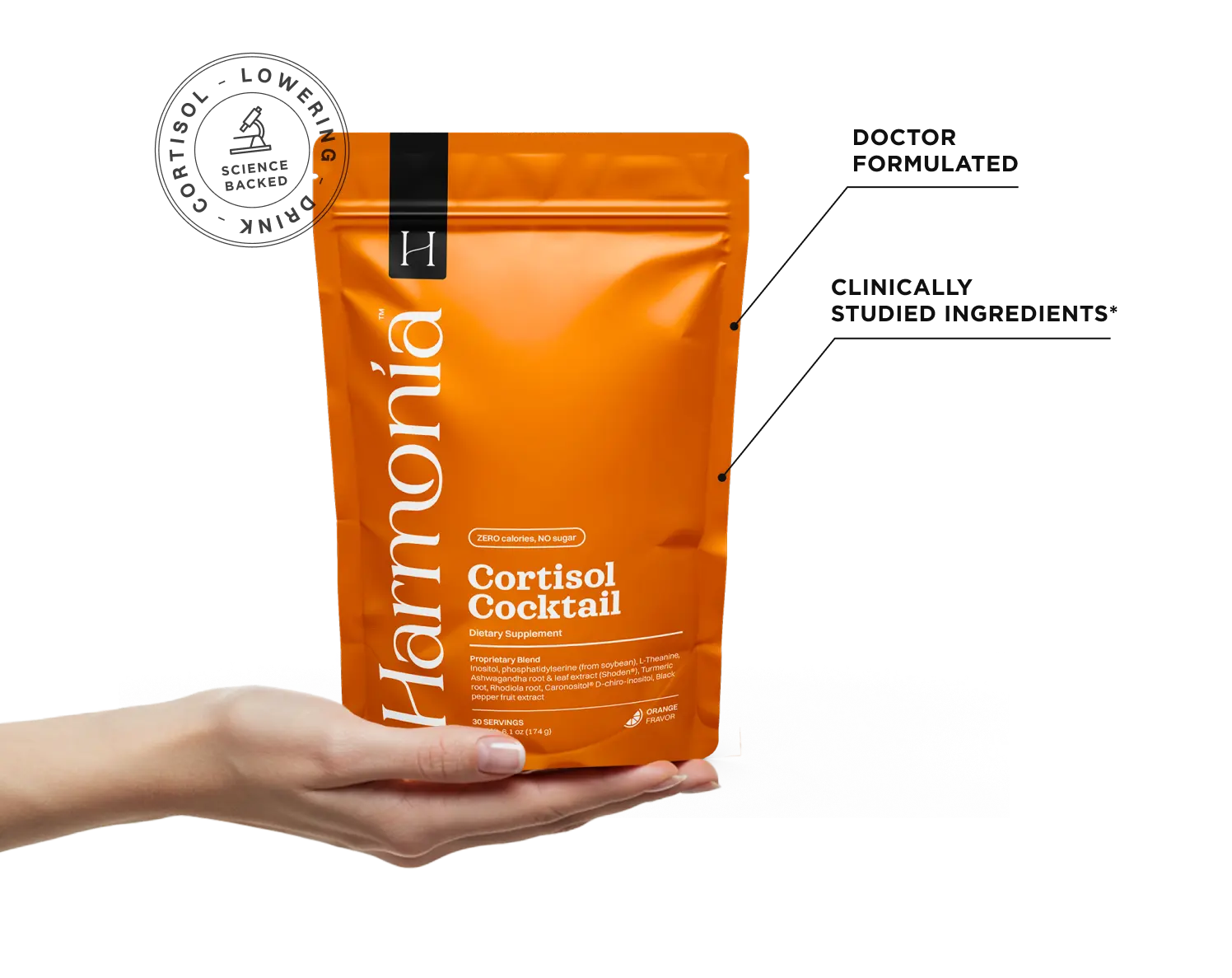
Ashwagandha is the lead ingredient in the Harmonia cortisol cocktail because it has the clearest human cortisol data among adaptogens. It is paired with Rhodiola rosea for stress-fatigue support and myo-inositol because chronic stress can feed into insulin and androgen disruption, which is where the broader hormonal picture starts to matter.

Phosphatidylserine
Phosphatidylserine has the strongest fit for acute cortisol spikes, especially exercise-related cortisol.
One 2008 double-blind, placebo-controlled crossover study in 10 healthy men found that 600 mg per day for 10 days reduced peak cortisol by about 39% and cortisol area-under-the-curve by about 35% after moderate-intensity exercise.
That is meaningful, but the context is the point. The best evidence is about cortisol response to physical stress, not chronically elevated baseline cortisol.
This may fit you if your cortisol spikes track with intense training, under-recovery, shift work, or short bursts of pressure.
This may fit you if your cortisol spikes track with intense training, under-recovery, shift work, or short bursts of pressure. The full breakdown of phosphatidylserine for cortisol covers the dosing protocols, what the research does and doesn't say, and how it compares against other options at the acute end of the spectrum.
The usual dose range is 400 to 800 mg daily, with many stress-response studies using 600 to 800 mg.
Tomorrow’s move: use phosphatidylserine for spike patterns, not as your first choice for long-term HPA axis stress.
Rhodiola rosea
Rhodiola has good human data for stress-related fatigue, especially when stress feels like exhaustion with a wired edge.
Early research suggests Rhodiola may help regulate the cortisol awakening response. A 2009 randomized, double-blind, placebo-controlled trial in 60 adults with fatigue used 576 mg daily for 28 days and found improvements in fatigue along with a reduced cortisol response to awakening stress.
Rhodiola contains rosavins and salidroside, compounds that appear to influence stress signaling through the HPA axis and brain pathways involved in perceived stress and fatigue.
The usual dose range is 200 to 600 mg daily of standardized extract. Some people feel it sooner than ashwagandha, sometimes within 2 to 4 weeks.
It can feel stimulating, so morning use usually makes more sense than taking it at night.
Magnesium
Magnesium can help if low intake or deficiency is adding strain to your stress response.
Magnesium is involved in more than 300 enzyme systems, including nerve function, blood glucose control, and blood pressure regulation. A magnesium and stress review describes a two-way relationship: stress can lower magnesium status, and low magnesium can make the stress response more reactive.
A review of anxiety studies found suggestive evidence that magnesium may reduce subjective anxiety in vulnerable people, though the authors rated the evidence quality as limited.
That puts magnesium in a useful but more modest category. It is better supported as nervous system and deficiency support than as a direct cortisol-lowering supplement.
Common doses are 200 to 400 mg daily. Magnesium glycinate is often better tolerated near bedtime than magnesium oxide.
Tomorrow’s move: if you rarely eat leafy greens, legumes, nuts, seeds, or dark chocolate, magnesium is a reasonable trial.
L-theanine
L-theanine is best for acute stress, caffeine anxiety, and calm focus.
One 2021 randomized, triple-blind, placebo-controlled crossover study gave 200 mg of L-theanine to healthy adults around an acute mental arithmetic stress test and found beneficial effects on salivary cortisol, blood pressure, brainwave activity, and self-reported anxiety.
That makes it practical for a presentation, tense conversation, or caffeine-heavy morning. It is less convincing as your main plan for chronically elevated cortisol.
The usual dose is 100 to 200 mg, either as needed or daily.
If coffee makes you anxious, L-theanine with caffeine may be a better experiment than adding more caffeine to push through.
Omega-3 fatty acids
Omega-3s may support cortisol indirectly through inflammation and stress reactivity.
One study in healthy men found that fish oil blunted adrenal activation during a mental stress test after three weeks of supplementation. The dose was high, so you should not copy it without clinical guidance.
This is a different kind of cortisol support. Omega-3s do not behave like ashwagandha or phosphatidylserine. Their best case is reducing inflammatory signals that can make the HPA axis more reactive.
For general health, many people aim for at least 1 gram per day of combined EPA and DHA. Higher doses can interact with blood thinners or bleeding risk, so dose matters.

What about vitamin C, holy basil, and probiotics?
Vitamin C, holy basil, and probiotics show up on many cortisol supplement lists. They belong in a lower evidence tier.
Vitamin C has a real biological connection to the adrenal glands, which contain high concentrations of vitamin C. Some studies suggest vitamin C may blunt cortisol responses after intense physical stress, especially at higher doses, but the evidence is more context-specific than ashwagandha.
Holy basil, also called tulsi, has animal data and small human studies suggesting stress-related benefits. The human cortisol evidence is not strong enough to rank it with ashwagandha or phosphatidylserine.
Probiotics are more interesting when stress and digestion travel together. A 2021 randomized, double-blind, placebo-controlled trial in 111 stressed students found that a multi-strain probiotic improved stress-related scores and serum cortisol compared with placebo.
If stress wrecks your digestion, a probiotic may help the gut-brain side of the stress response. For direct cortisol reduction, start with better-matched options first.
Evidence tier table
How to lower cortisol levels beyond supplements
Supplements can modulate your stress physiology. They cannot remove the stressor driving it.
If your cortisol is high because you are sleeping five hours, skipping meals, overtraining, and answering work messages at midnight, ashwagandha can help at the edges. Your body will still keep reading the situation as unsafe.
Sleep is the biggest lever. A classic sleep restriction study found that partial and total sleep deprivation raised evening cortisol the next day, with increases during the 6 p.m. to 11 p.m. window.
Food timing matters too. Long gaps between meals can make the cortisol and blood sugar cycle more noticeable, especially if stress already leaves you shaky, hungry, or wired in the afternoon.
The practical baseline is simple: keep your wake time consistent, get outdoor light within an hour of waking, eat enough protein, and cut caffeine after lunch if your sleep is fragile.
For hormonal support, Harmonia Cortisol Cocktail combines ashwagandha and Rhodiola rosea to help the body manage its stress response and support healthier cortisol patterns. Myo-inositol is included for a different reason: ongoing stress can affect insulin function and hormone balance in some people, so supporting insulin sensitivity gives the formula broader hormonal support.
_11zon.jpeg)
Breathing is also more evidence-based than it sounds. A randomized trial in 40 adults found that diaphragmatic breathing training improved attention, mood, and cortisol response compared with control.
Try five minutes before bed: inhale for four counts, exhale for six counts. Longer exhale, lower gear.
Tomorrow’s move: choose one supplement and one non-supplement action. Pairing ashwagandha with a steady wake time will usually beat taking four supplements while keeping the same stress pattern.
How to choose the right cortisol supplement
Start with the pattern, then choose the supplement.
If you are chronically stressed, tense, wired at night, and your symptoms have lasted months, ashwagandha is the strongest first choice.
If your issue is acute spikes, such as workouts, intense shifts, or performance stress, phosphatidylserine or L-theanine makes more sense.
If you feel exhausted but overstimulated, Rhodiola may fit better. If you sleep poorly, cramp often, or eat low-magnesium foods, magnesium is a reasonable baseline step.
If your symptoms include irregular cycles, cravings, mood shifts, sleep changes, and skin changes, supplements to reduce cortisol and belly fat can also support the metabolic and body composition changes linked to chronic stress.
Do not start everything at once. Start one supplement, take it consistently, and track three things for four weeks: sleep onset, waking time, and afternoon energy.
If you menstruate, track cycle changes too. That gives you better feedback than judging a supplement after one unusually stressful day.
Safety notes before you start
Cortisol supplements are still biologically active.
Ashwagandha may interact with thyroid medications, sedatives, immunosuppressants, and autoimmune conditions. It has also been linked to rare liver injury reports, so stop using it and seek medical care if you develop yellowing skin, dark urine, severe fatigue, or upper abdominal pain.
Rhodiola can feel stimulating and may not suit you if you are prone to agitation or bipolar symptoms.
Phosphatidylserine is usually well tolerated, but higher doses can cause digestive upset or sleep changes in some people.
Magnesium can loosen stools, especially citrate and oxide forms. If you have kidney disease, check with your clinician before supplementing.
If you are pregnant, breastfeeding, taking psychiatric medication, on thyroid medication, using blood thinners, or being treated for an endocrine disorder, get personalized guidance before starting a cortisol-focused stack.
The bottom line
Ashwagandha has the strongest human evidence for chronic stress and serum cortisol reduction. Phosphatidylserine is best supported for acute cortisol spikes, especially exercise-related ones. Rhodiola has promising human data for stress-related fatigue and cortisol awakening response.
Magnesium, L-theanine, omega-3s, vitamin C, holy basil, and probiotics can all have a place. The cortisol cocktail guide is useful if you want to understand why certain ingredients are paired together instead of treating every stress supplement as interchangeable.
The Harmonia cortisol cocktail is built around that same logic: ashwagandha for clinically studied cortisol reduction, Rhodiola rosea for stress-fatigue physiology, and myo-inositol for the insulin and androgen side of chronic stress. That is the reason those ingredients are there.
If you have been trying to lower cortisol but still feel like stress is showing up in energy, cravings, sleep, or hormone symptoms, take the Harmonia quiz to find out whether the cortisol cocktail fits what you are already noticing in your body and whether it is a good fit for where you are right now.
Frequently asked questions
What supplements lower cortisol the fastest?
L-theanine and phosphatidylserine may work fastest for acute stress because they can affect the stress response around a specific event. L-theanine is usually used at 100 to 200 mg, while phosphatidylserine studies often use 600 mg daily for short periods. For baseline cortisol, ashwagandha usually takes several weeks.
What is the best supplement for high cortisol at night?
Ashwagandha is the best-studied option for chronically elevated cortisol, but magnesium glycinate may be more helpful if your main issue is physical tension and sleep onset. If your evening routine includes caffeine, bright light, or late work, the best tea to reduce cortisol approach may be a better first experiment than adding more capsules.
How can I lower cortisol levels naturally without supplements?
Keep your wake time consistent, get morning light, eat enough protein and carbohydrates, and stop doing intense exercise when you are already under-recovered. Slow breathing can also help shift your body toward a calmer stress state. The fastest practical change is usually cutting afternoon caffeine and protecting the final hour before sleep.
Do supplements to reduce cortisol help with belly fat?
They can help if cortisol is part of your belly-fat pattern, but they will not override poor sleep, under-eating, alcohol, or insulin resistance. Chronically elevated cortisol can affect appetite, blood sugar, and fat storage patterns, which is why the cortisol and belly fat connection matters before you choose a supplement stack.
Can low cortisol feel like high cortisol?
Yes, some symptoms overlap, especially fatigue, brain fog, dizziness, and poor stress tolerance. Low cortisol is a medical issue and should not be treated with cortisol-lowering supplements. If you feel faint, lose weight unintentionally, crave salt intensely, or have very low blood pressure, ask your clinician about proper testing.
Should I test cortisol before taking supplements?
Testing is helpful if symptoms are severe, long-lasting, or confusing. A four-point salivary cortisol test can show your daily curve better than a single morning blood draw. If your symptoms are mild and clearly stress-related, you may reasonably start with sleep, food timing, and one low-risk supplement while tracking changes.
References
- Chandrasekhar K, Kapoor J, Anishetty S. A prospective, randomized double-blind, placebo-controlled study of ashwagandha in adults with chronic stress. Indian Journal of Psychological Medicine. 2012. Link
- Lopresti AL, Smith SJ, Malvi H, Kodgule R. An investigation into the stress-relieving and pharmacological actions of ashwagandha. Medicine. 2019. Link
- Starks MA, Starks SL, Kingsley M, Purpura M, Jäger R. The effects of phosphatidylserine on endocrine response to moderate intensity exercise. Journal of the International Society of Sports Nutrition. 2008. Link
- Olsson EMG, von Schéele B, Panossian AG. Rhodiola rosea in stress-related fatigue. Planta Medica. 2009. Link
- Pickering G, Mazur A, Trousselard M, et al. Magnesium status and stress. Nutrients. 2020. Link
- Hidese S, Ogawa S, Ota M, et al. Effects of L-theanine on stress-related symptoms. Nutrients. 2019. Link
- Delarue J, et al. Fish oil prevents the adrenal activation elicited by mental stress. Diabetes & Metabolism. 2003. Link
- Langgartner D, et al. Multi-strain probiotic effects on perceived stress and cortisol in stressed students. 2021. Link